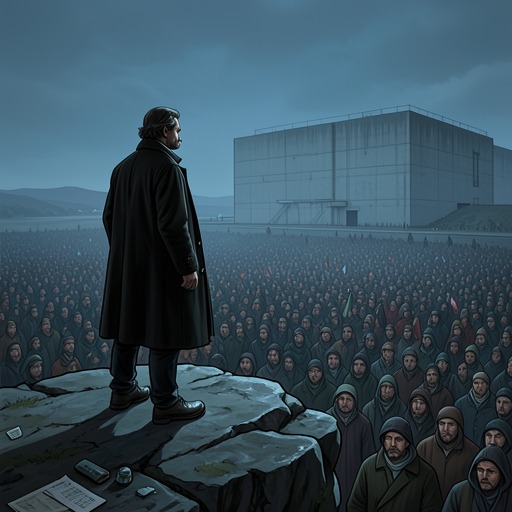
The State
Thus Spoke ZarathustraIn “Of the New Idol,” The State is Zarathustra’s name for a political power that falsely claims to represent the people and, in doing so, turns collective life toward self-loss and death. Its defining operation is not merely rule but substitution: it takes the language, creations, and shared purposes of a people, then presents its own authority as their common life. Zarathustra opposes this manufactured unity to the possibility of a free life beyond the state, where the unique person can begin to create again.
The Idol and Its Claim
The passage opens by distinguishing peoples and herds elsewhere from the conditions Zarathustra describes among his brothers: there, instead, are states. His question about what the state is introduces a deliberately stark answer. The State is the coldest of cold monsters, and its defining lie is the claim that it is the people. The image of the monster gives political authority an alien, almost predatory form; the claim to speak for everyone then makes that strangeness harder to see, because it disguises an institution as the collective itself.
Zarathustra counters that claim with an account of how peoples come into being. Creators, he says, made peoples and placed faith and love over them, serving life in the process. Destroyers, by contrast, set snares for many and call their construction the state; above those caught in it they hang a sword and a hundred desires. The contrast is not simply between one institution and another. It is between creation that binds people through shared commitments and an imposed order that gathers people through danger and multiplied wants. The state’s claim to embody a people thus reverses the account of who made that people and what their creation served.
Language, Custom, and Appropriation
The passage presents custom and law as the languages through which peoples distinguish good from evil. Each people invents its own moral language, and a neighboring people may not understand it. This particularity matters: shared life is made through meanings shaped within a people, not automatically supplied by a power speaking in everyone’s name. Where a people remains, Zarathustra says, that people neither understands the state nor accepts it as its own; it hates the state as an evil eye and as a violation of custom and law.
The State, in contrast, lies in every language of good and evil. The image makes its falsehood more than a mistaken statement: the state crosses the differences between peoples’ moral vocabularies while claiming authority over them, and whatever it possesses, Zarathustra says, it has stolen. The accompanying image of stolen teeth makes this appropriation seem built into the state’s very manner of acting; even its belly is false. The repeated stress on falseness turns its claim to common identity inside out. What looks like a body that could contain and sustain a people is described instead as an imitation whose contents and means have been taken from elsewhere.
The State as a Machinery of Death
Zarathustra offers confusion in the language of good and evil as the state’s sign, and reads that sign as indicating a will to death. The state beckons to preachers of death because its deadly consequences can be made to look like public service and life. Its design is described as a cunning device of Hell: a horse of death adorned with the trappings of divine honors. The contrast between the vehicle’s purpose and its honored appearance exposes the work of political language in this passage. Destruction is not openly named as destruction; it is dressed in sanctity and presented as service to the many.
The consequence, Zarathustra declares, is a state in which good and bad alike become poison-drinkers and lose themselves. The most startling reversal follows: universal slow suicide is called life. This phrasing makes the state’s danger collective rather than confined to a single ruler or group. The alleged beneficiaries and the alleged opponents are both drawn into a condition that consumes their capacity to live as themselves, while the name of life conceals the loss.
The attack extends to the people Zarathustra calls superfluous. They steal the works of inventors and the treasures of the wise, rename their theft culture, and turn what they take into sickness and calamity. Their public expression is figured as illness: they vomit bile and call it a newspaper, devour one another, and cannot digest themselves. These images connect the state’s false public language to a wider failure of creation and assimilation. Invention and wisdom are not honored as living sources; they are appropriated, relabeled, and made part of a culture that cannot inwardly make use of what it consumes.
Beyond the State
The alternative appears not as a program for replacing the state with another political structure, but as a possibility of space and freedom beyond it. Zarathustra says that the earth still remains free for great souls. Many places, with the odor of tranquil seas blowing about them, remain empty for solitaries and solitary couples. Against the state’s gathering of the many under a common claim, the passage sets places still available to those who can live apart. It does not describe a particular community or a plan of government; its contrast is between imposed collectivity and room for unforced, solitary life.
This freedom also has an economic and personal measure: the one who possesses little is less possessed, and moderate poverty is praised. The formulation links ownership to reciprocal captivity. Having less may mean being less held by what one has, in contrast to the state’s swollen desires and the appropriations attributed to its superfluous people. The passage’s praise is for moderation, not for a detailed code of deprivation; its point is that freedom depends partly on limiting what can claim possession of a person.
Only where the state ceases, Zarathustra says, does the non-superfluous person begin: a necessary person whose song is unique and irreplaceable. The ending turns the argument from denunciation toward creation. Beyond the state’s confused moral language and borrowed culture, the individual is not merely released from an institution but becomes capable of a distinctive contribution. Zarathustra asks his brothers to look toward the rainbow and the bridges to the Superman. The image does not promise that the state itself will produce that future. Rather, its cessation opens a path on which singular lives may help make the passage toward the Superman possible.